
Automated Breast Ultrasound
Breast Ultrasound Screening for Dense Breasts
With 3D ultrasound and Automated Breast Ultrsound (ABUS) software, radiologists can look through hundreds of breast tissue image “slices,” looking at layers of dense tissue to find breast cancers which may have been missed on a mammogram. This is different than routine ultrasound of the breasts since the images from ABUS allow you to see in projections that routine ultrasound cannot, which results in the ability of physicians to detect more breast cancers and less false negatives (findings due to images which are not cancer).
Other Facts about ABUS:
• FDA-approved technology
• Insurance does cover this exam, however it is not covered under preventative care at this time and may go toward a deductible.
• ABUS does not replace a mammogram
• ABUS is recommended for patients with strong family history or whose mammogram reported “extremely dense”, “heterogeneously dense”, and “moderately dense” breast tissue.
What is Breast Density?
While dense breast tissue is perfectly normal – affecting approximately 40 percent of the population – breast density cannot be felt and it is not related to breast size or firmness. It can only be seen on a mammogram.
Breast tissue is considered dense if there is a lot of fibrous or glandular tissue and not much fat. Fibrous and glandular tissue looks white on a mammogram, as does a possible tumor. This makes it difficult to tell the difference between a tumor and dense breast tissue on a mammogram.
Women with dense breasts should consider talking with their doctor about additional screening exams such as ABUS or Abbreviated breast MRI.
Breast Density Scale:
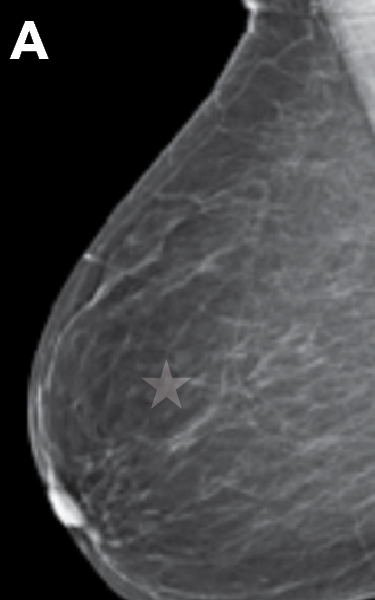
Almost entirely fatty
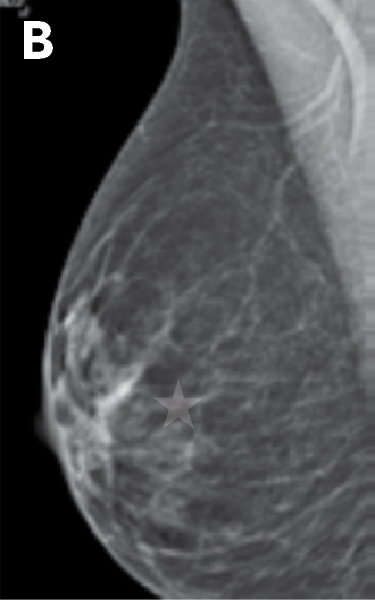
Scattered areas of fibroglandular density
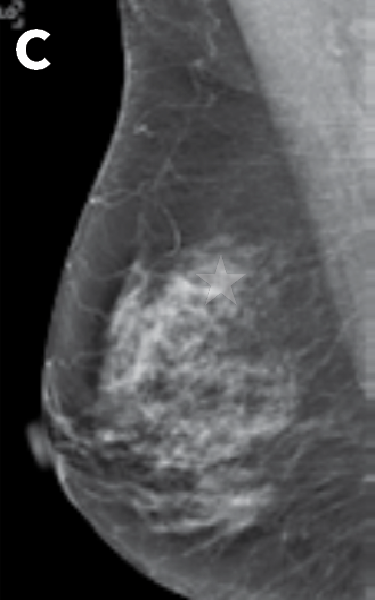
Heterogeneously dense
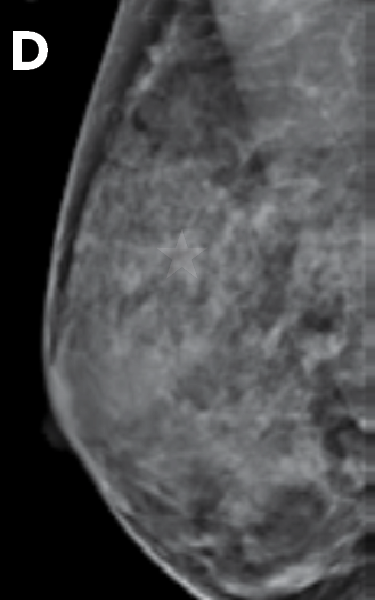
Extremely dense
Dense breasts are identified by a radiologist using mammography exams. Physical touch or self-exams cannot identify dense breasts. The mammogram offers clarity to the amount of dense tissue compared to fatty tissue and specifies what level of density the breast tissue is. The mammography report sent to your referring provider will have the details about density levels.
Radiologists classify breast density using a four-level scale (A-D). Category A is almost all fatty tissue and category B is scattered fibrous tissue. Both A and B are considered NOT DENSE. Category C is classified as heterogeneously dense and category D is extremely dense. Both C and D are considered DENSE breast tissue.
Mammography remains the gold standard for all women 40 or older. You should continue to get your mammogram annually. However, there are supplemental exam options that your doctor may recommend. Because dense tissue can hide cancers and independently increases risk, additional tests like breast ultrasound or MRI are recommended to improve detection rates. Ask your doctor if supplemental exams may be right for you. If they are, we also perform many of those exams at our outpatient center and will be happy to coordinate all your breast imaging needs.